
“Predictability is the New Incentive: A Roadmap for Investor Confidence in Albania”
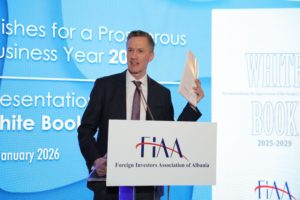 Monitor: What is the message that the government should take from the White Book?
Mr. Reveszs: The White Book 2025–2029 should be viewed by the government as a strategic partnership roadmap rather than a list of demands. The primary message is one of partnership and predictability, emphasizing the need for a collaborative roadmap to align Albania’s business climate with European Union standards. A draft response for a business magazine suggests focusing on three key pillars: predictability through consultation via a permanent mechanism, administrative consistency away from decentralized or ambiguous law administration, and alignment with the EU Growth Plan given that 98% of foreign investors are eager for EU integration benefits. The core message is that transparency and stability are crucial for attracting high-quality foreign direct investment.
The White Book refers to a decline in the perception of the business climate from the most recent Survey to 45 points from 49 a year ago. What are the main factors that are weakening investor confidence today and their expectations for the future?
According to the FIAA Business Environment Survey 2025, the perception of the business climate in Albania has decreased to 45 out of 100 points, down from 49 the previous year. Factors weakening investor confidence include macroeconomic volatility, rising corruption, labor market shortages, legislative instability, and administrative ambiguity.
Consultations with businesses have highlighted that frequent changes in fiscal legislation are one of the main concerns. Is the bigger problem the level of taxes or the lack of predictability? And is Albania losing investment due to this regulatory risk?
In our analysis and in ongoing conversations with FIAA members, it turns out that the lack of predictability is a much bigger challenge than the tax level itself. The biggest problem is precisely the unpredictability of changes and the lack of sufficient time and a regular process of public consultation with businesses and experts, before sending draft laws to parliament or approving sub-legal acts. This dynamic regulatory framework that is present does not provide sufficient predictability for foreign investors, who build their short- and medium-term budgets also on the basis of anticipated legal changes. And it also does not allow foreign investors affected by legal changes to be sufficiently heard and taken into consideration before their approval.
When the rules of the game change frequently and without prior and proper consultation, this creates high administrative costs and uncertainty in calculating the return on investment. For an investor, fiscal stability is worth more than a low but uncertain tax rate.
Regarding the loss of investments, we must be realistic that Regulatory Risk is an invisible tax. Albania is not only losing potential investments that choose other countries in the region with more stable legislation, but also risks the lack of expansion by existing investors. For this reason, the White Paper 2025-2029 strongly urges the creation of a sustainable fiscal calendar and an institutional dialogue where the voice of business is heard before the changes enter into force, and not after they have become a fait accompli.
Another aspect that is brought to attention is the delay in VAT reimbursement. Do you see this as a technical administrative problem or as a systemic risk for capital investments, especially in export sectors?
VAT refunds should not be seen simply as an administrative process, but as a pillar of mutual trust between the state and business. While we recognize the positive steps that have been taken through the fiscalization and automation process, the delays that are still encountered remain a serious concern. In the White Book, we treat this not simply as a technical problem, but as a systemic barrier to investment. An efficient VAT refund system is vital for companies’ liquidity, especially at a time when global capital costs have increased, as well as to aid financial predictability as companies need to have certainty over their cash flow.
 The year 2026 marks 10 years since the adoption of the justice reform and investors are evaluating the judiciary with caution. From the FIAA’s perspective, how has its performance and impact been and what needs to be further improved in order to increase investor confidence and security?
It is still too early to ascertain tangible results of the Reform. However, in this decade of the Justice Reform, FIAA remains a supporter of this process, considering it as the main prerequisite for a healthy market economy. We appreciate the fact that the new justice institutions are already functional and are giving clear signals for the increase of integrity in the system. However, from the investor’s perspective, ‘justice delayed is justice denied’. For us, the biggest challenge today remains the high backlog of files and the length of court proceedings for reviewing cases, especially those in the Administrative Court of Appeal that businesses encounter most frequently. For a business, waiting several years for a court decision means frozen capital, operational uncertainty and, in some cases, jeopardizing the existence of the investment.
In the White Book 2025-2029, we emphasize that to increase investor confidence, the reform must move into its operational efficiency phase. This includes Specializing judges in complex commercial and financial matters, to guarantee quality and predictable decisions, widely using digitalization in the judicial system to increase transparency and speed up procedures, and strengthening alternative dispute resolution mechanisms, such as arbitration and mediation, to ease the burden on the courts. Investor confidence is not built solely on the existence of good laws, but on the guarantee that in the event of a conflict, they will have access to a prompt, independent and professional judicial process. This remains the true test of the success of the reform in the years to come.
Informality and unfair competition also remain a point of discussion, and this at a time when the government will also implement fiscal peace. In your view, how does this approach affect the business environment? Are informal actors really being punished, or are regular businesses being penalized more? How should the control policy be reformatted?
Informality remains one of the most critical challenges for the business environment in Albania. In the FIAA’s view, regular businesses today feel a disproportionate burden. While informal actors often operate ‘under the radar’, transparent businesses are subject to frequent and detailed controls. This creates the feeling that the tax administration is focusing on where it is easiest to collect revenue, instead of expanding the taxpayer base by going after those who hide from the system. Without a real fight against unfair competition, serious investors will find it difficult to justify capital investments in a market where the price of a product or service is not determined by efficiency, but by tax avoidance.
How do labor problems affect the approach of current and potential investors?
This is one of the most urgent challenges we have addressed in the White Paper 2025–2029, as human capital is the engine of any investment.
Today, the first question a potential investor asks is no longer ‘how much is the tax?’, but ‘are there enough qualified people to do the job?’.
For current investors, this situation is increasing operating costs. They are facing a ‘war for talent’, where high staff turnover and wage increases often unaccompanied by productivity gains put pressure on business sustainability. For potential investors, especially in the technology, manufacturing and value-added services sectors, the lack of a sufficient ‘pool’ of employees may be the main reason not to choose Albania.
In the White Book, we propose a three-pronged approach: Education and Re-skilling, Facilitation of Procedures for Foreign Labor, and Incentives for Innovation. Our message is simple: Without an aggressive national strategy for talent and labor, we risk losing our competitive advantage as an investment destination.”
EU integration is expected to bring challenges as well as benefits. Which EU-related reform would have the greatest economic, not political, effect if implemented properly and would serve the investment climate?
If we had to single out a reform with the greatest direct economic impact, it is undoubtedly the Approximation of Legislation and Standards with the European Single Market, accompanied by the Strengthening of the Rule of Law in economic matters. Unlike political reforms, the implementation of EU standards in the economy has the effect of a ‘universal passport’ for businesses in Albania.
In the White Book, we see EU integration not as a destination, but as an instrument of modernization. The reform that would serve us most is the one that transforms our public administration from a ‘controller’ to a ‘facilitator’ of European standards. When the rules in Tirana are the same as those in Vienna or Rome, the perceived risk of investment decreases and foreign capital comes naturally.
How does the performance of the administration and other economic aspects related to infrastructure, logistics, and energy affect investor access?
For an investor, the efficiency of the administration and the quality of the infrastructure are not just conveniences, but direct factors in the cost of the final product. If the infrastructure or administration does not function at the pace of the market, the investor loses the competitive advantage. In the FIAA’s view, there are pillars that dictate the decision to stay or expand in Albania, which are those where the Administration is seen as a Partner and not as an Obstacle.
Investors appreciate the progress with the digitalization of services (e-Albania), but the challenge remains ‘human bureaucracy’. We seek an administration that has a service mentality, where deadlines are respected and where the interpretation of the law is uniform. Any delay in permits or licenses is an opportunity cost that discourages new capital.
In the White Book, we emphasize that Albania must stop identifying itself as a country with ‘cheap labor’ and start competing as a country with ‘efficient logistics and green energy’. This is the transformation that foreign investors expect.
What message do you have for investors who today view Albania with interest, but also with reservations? What are the most interesting areas that can develop activity in Albania?
My message to investors who are still in the observation phase is this: Albania is no longer a ‘peripheral market’, but an economy on the verge of full integration into the European family. The reservations are understandable in any emerging market, but the success story of many FIAA member companies shows that with the right partner and a long-term vision, the administrative challenges are surmountable.
We encourage investors to view the current reforms not as obstacles, but as ‘growing pains’ of a system that is being cleaned up and made more transparent. The White Book 2025–2029 is precisely our guarantee that the voice of investors is structured and is being heard at the highest decision-making levels.
As for areas of strategic interest, we see tremendous potential in areas such as Renewable Energy, Digital Technology and Services (ICT), Sustainable Tourism and Agribusiness, Logistics and Transport.
Our invitation is: Come and be part of the transformation. The Albania of 2030 is being built today, and those who invest now will be the main beneficiaries of convergence with the European market.