
Gateway of the Balkans, Heart of Europe.
Country’s Official name: REPUBLIC OF ALBANIA
Political system: PARLIAMENTARY REPUBLIC
President: BAJRAM BEGAJ
Prime Minister: Edi RAMA
Capital: TIRANA
Other important cities: Durres, Shkodra, Vlora, Korca, Fier, Gjirokastra, etc.
The official language: ALBANIAN
The national Currency: LEKE
Population: 2.363.314 (Source: INSTAT January 2025)
Main Investment areas and sectors: Energy, Mining Industry, Oil and Gas, Tourism, Agriculture and Food, Manufacturing, BPO Industries, Telecommunications etc.
LOCATION AND CLIMATE
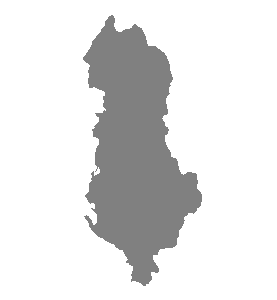
Albania is a small country located in South-Eastern Europe, on the western part of the Balkan Peninsula. It covers an area of 28,748 square kilometers and lies between 39°38′ and 42°39′ north latitude, and 19°16′ to 21°04′ east longitude. The country extends approximately 340 kilometers from north to south and up to 154 kilometers from east to west.
Albania is bordered by Montenegro to the northwest, Kosovo to the northeast, North Macedonia to the east, and Greece to the southeast and south. To the west and southwest, it is bordered by the Adriatic and Ionian Seas. Across the Adriatic Sea, approximately 70–80 kilometers away, lies Italy. Owing to its geographical position, Albania represents a strategic crossroads linking the Western Mediterranean with the Balkans and Asia Minor.
Albania has a predominantly Mediterranean climate, with continental influences in the interior and mountainous regions. The average annual temperature ranges between 13°C and 14°C. Temperatures are generally higher in the western lowlands and decrease by about 4–5°C in the northern and eastern areas. July is typically the hottest month, while January is the coldest.
Average annual precipitation is approximately 1,400–1,500 mm, though it varies significantly by region, with higher levels in mountainous areas. Rainfall is unevenly distributed throughout the year, with most precipitation occurring in late autumn and winter. July and August are typically the driest months, while November and December are the wettest.
Albanians refer to themselves as shqiptarë, often interpreted as “sons of the eagle,” and to their country as Shqipëria. Descendants of the ancient Illyrians, they possess a rich and distinctive historical and cultural heritage.
Owing to its strategic location along the Adriatic Sea, Albania has long served as a crossroads for civilizations and empires. In the 2nd century BC, the Illyrian territories were incorporated into the Roman Empire, and from the late 4th century AD they came under the rule of the Byzantine Empire. Over the centuries, the region experienced successive incursions by various groups, including Goths, Huns, and Slavic tribes. In the 15th century, Albania was gradually incorporated into the Ottoman Empire.
Ottoman rule, which lasted for more than four centuries, significantly shaped Albania’s social, political, and cultural development. In the late 19th century, the Albanian National Awakening (Rilindja Kombëtare) marked a renewed movement toward cultural identity, language, and political independence, alongside a reorientation toward Europe. Albania declared its independence in 1912; however, the subsequent delineation of its borders by the Great Powers in 1913 left substantial Albanian populations outside the new state.
Between the two World Wars, Albania was partly governed as a monarchy. Following World War II, in November 1944, it emerged as a communist state, where the ruling party exercised extensive control over political, economic, and social life. With the collapse of communist regimes across Eastern Europe beginning in 1989, Albania underwent a profound political transformation, leading to the establishment of a pluralistic democratic system.
This transition reaffirmed Albania’s orientation toward Europe and the West, while preserving its distinct cultural identity and historical heritage.
The first official population census in Albania was conducted in 1923, recording approximately 804,000 inhabitants. By 1945, the population had grown to around 1.12 million, and by the early 1990s it had reached approximately 3 million.
According to the 2001 Census, Albania’s population stood at 3,078,159, comprising 1,539,980 males and 1,547,179 females. At that time, about 42% of the population lived in urban areas, while 58% resided in rural regions. During the 1990s, more than 500,000 Albanians emigrated, primarily to Greece and Italy, leading to a significant decline in the resident population.
More recent data from INSTAT indicate a continued downward trend. As of 1 January 2025, Albania’s resident population was estimated at 2,363,314 inhabitants, representing a decrease of 1.2% compared to 1 January 2024. This decline reflects ongoing demographic challenges, including emigration, low birth rates, and population ageing.
